How to Build an AI Phone Agent That Books Appointments
A practical walkthrough for building an AI phone agent that books appointments: qualify the caller, check a real calendar, confirm the slot, and send proof.
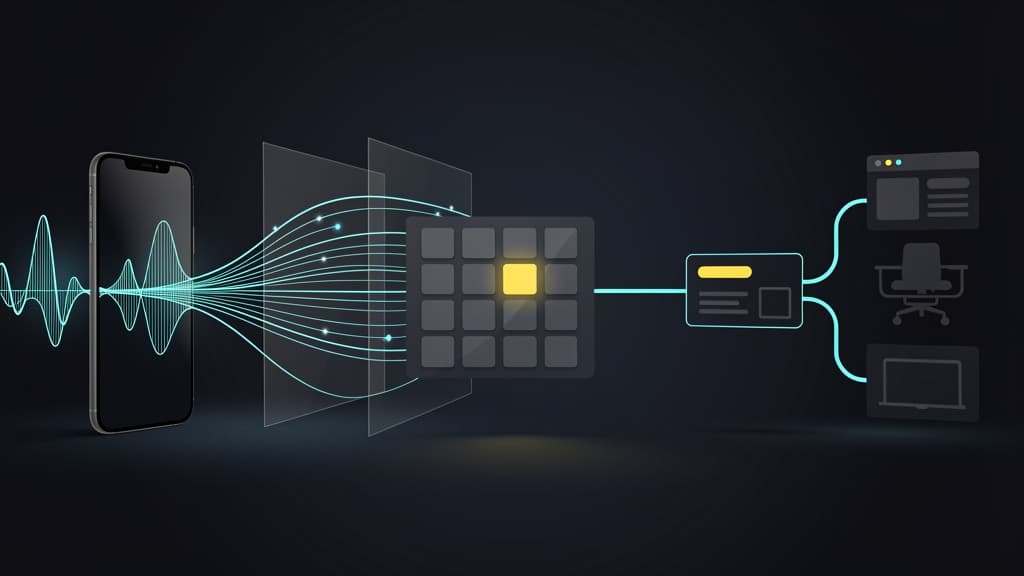
If you want to build an AI phone agent that books appointments, treat booking as a transaction rather than a line in the prompt. The system has to qualify a caller, read current availability, confirm the chosen slot, create one event, and recover safely when the calendar changes.
This guide maps that loop: greet, qualify, check availability, confirm, book, and send written proof. It is an implementation design to test in your own environment, not a guarantee of production readiness.
The architecture in one breath
A recommended design separates the appointment-booking phone agent into three layers:
- The voice layer handles the live audio: turn-taking, interruption handling, speech-to-text, and text-to-speech.
- The brain is your prompt plus a small set of tools (functions) the agent can call mid-conversation — check slots, create a booking, look up a contact.
- The backend is where those tools actually run: your calendar, your CRM, your automation platform. This is your logic, and you want it somewhere you control.
This separation makes fallback, branching, and integration behavior easier to test. Keep the voice platform focused on the conversation and put booking logic behind a small, observable set of functions.
Step 1 — Decide what "qualified" means before you write a word
The agent can only book good appointments if you've defined what a good appointment is. Do this on paper first. For an inbound agent that might be:
- Is this a new lead or an existing customer? (Look them up by phone number.)
- Are they in your service area / do they need the thing you actually sell?
- Which service or appointment type do they want, and how long does it run?
Turn those into two or three questions the agent asks naturally, not an interrogation. The goal of qualification is routing: a qualified caller proceeds to booking, while an out-of-scope caller receives a polite handoff or message-taking path. Define and test that branch before launch.
Step 2 — Give the agent tools, not a script
Your prompt sets tone and rules. The actions live in functions the agent calls. A compact implementation can expose three narrowly scoped tools:
lookup_caller(phone_number)— returns the caller's name and status so the agent can greet a known caller personally.get_availability(service_type, date_range)— returns a small, tested number of open slots that the agent can read clearly.book_appointment(slot, contact, service_type)— writes the event and returns success or a clear reason for failure.
Write each function's description like an instruction, not a label: "Call this to offer open times once the caller has said they want to book." The description should state when to call the tool, and acceptance tests should cover both missed and unnecessary tool calls.
Step 3 — Connect a real calendar
This is the step people underestimate. Reading and writing a live calendar under the pressure of a phone call has three requirements:
- Measured latency. Measure P50 and P95 for
get_availabilityin the deployed region, set an explicit timeout, and test a spoken fallback when the lookup cannot finish in time. - A conflict-safe write. Re-check availability inside
book_appointmentimmediately before insertion and branch on failure: "That one just filled — the next opening is 3:15, does that work?" - Idempotency. Use an operation-specific booking key, such as
call_id + function_name + normalized appointment slot, rather thancall_idalone. For Google Calendar, a conforming client-generated event ID can help prevent duplicate event creation after an ambiguous write.
If your business already runs on GoHighLevel, the platform documents calendar booking for its own Voice AI. A third-party agent needs a separately verified integration. If you're wiring custom logic across a CRM, calendar, and SMS, an orchestration layer like n8n can keep that logic versioned and testable.
Step 4 — Confirm out loud, then send written proof
Before the agent writes anything, it should read the booking back: "So that's a 30-minute consultation Thursday the 25th at 2 PM — sound right?" Verbal confirmation catches the caller mishearing the day, and it catches the agent mistranscribing it.
After the write succeeds, send an SMS or email confirmation from your backend so the caller has the appointment details in writing. If you add reminders or rescheduling through an SMS agent, apply the relevant consent, channel, and opt-out rules.
Step 5 — Read transcripts before you touch the prompt
Once an approved pilot is running, sample only the fields needed for a defined quality purpose—for example the outcome, function timings, and a purpose-limited transcript sample. Apply consent rules, PII controls, least-privilege access, and the approved retention period.
Review the sample for observable failure modes: offers made before qualification, unanswered questions, slow P95 lookups, calendar conflicts, and failed handoffs. Use those findings to choose the next prompt or workflow change.
Gotchas that will bite you
A few things worth internalizing before a real number goes live:
- Unexplained delay. If a function is slow, use a brief acknowledgement and a tested timeout path instead of leaving the caller without feedback.
- Double bookings. Re-check at write time and use an operation-specific booking key. Retell lifecycle webhook retries are separate from custom-function booking behavior.
- The out-of-scope caller. Always have a graceful path for someone you can't book — take a message, offer a callback, hand to a human.
- Cost drift. Voice minutes plus LLM tokens plus telephony add up. Log per-call spend and load-test before launch, not after the bill.
The honest bar
The release bar is observable booking success, duplicate prevention, recoverable calendar conflicts, written confirmation, and a tested human fallback. Record the failures as well as the successful path.
If you need help implementing qualification, conflict-safe calendar writes, duplicate protection, and written confirmation, get in touch. You can also review my technical background.
USMAN://CTA
Got a build like this in mind?
I ship AI voice agents, automations, and full-stack products. Let's talk about yours.
START A PROJECT